
Yes, North Carolina levies an excise tax of $1 for every $500 (or fraction of $500) of the property's value. This tax applies statewide under Article 8E of the North Carolina General Statutes, and


Dated: September 24 2026
Views: 0

North Carolina's main down payment assistance options are the NCHFA 3% DPA and the $15,000 NC 1st Home Advantage, both paired with the NC Home Advantage Mortgage, plus city programs like Durham's DPA (up to $80,000) and Raleigh's homebuyer assistance. Most function as deferred second loans that forgive over time rather than free money, and funding is capped by household income and location. Your next move: call a participating lender now and confirm your area median income (AMI) bracket and whether your target property sits inside city limits.
TL;DR:
- Most North Carolina down payment assistance programs are deferred loans that forgive over time, with funding limited by household income and location.
- Durham and Raleigh city programs can offer up to $80,000 or more, but are restricted to properties within city limits and have specific income and property price caps.
- The two main state programs, the 3% DPA and $15,000 first-time buyer aid, are structured as 15-year subordinate loans requiring careful timing and lender coordination.
- Applicants must meet first-time buyer, credit, debt-to-income, citizenship, and property eligibility criteria before applying.
- Funding availability varies weekly; buyers should verify current funds with lenders and consider program deadlines before making offers.
Buyers in North Carolina typically choose from three categories of assistance, and each works differently once you dig past the marketing language.
Most of these arrive as a deferred subordinate lien, meaning you owe nothing monthly, but the balance sits behind your first mortgage until it's forgiven or triggered by a sale. A smaller number forgive automatically on a fixed schedule, and outright grants with no repayment condition are rare in this state.
Nearly every program shares the same gatekeeping questions: are you a first-time buyer (or a veteran, who often gets an exception), does your household income fall under the local AMI ceiling, is the property in a targeted census tract, and is funding still available this quarter? Answering those four questions early saves weeks of wasted lender back-and-forth.
The North Carolina Housing Finance Agency runs the two programs most buyers mean when they search for down payment assistance in North Carolina. Both require the NC Home Advantage Mortgage, and both are structured as 15-year subordinate loans, not cash gifts.
Pro Tip: Ask your lender for the subordinate lien's separate Loan Estimate before you compare offers. NCHFA guidance requires it, and skipping this step is how buyers get blindsided by closing costs.
The program guide also spells out three operational details buyers overlook: funding only flows through participating lenders, cash back at closing is capped, and any future refinance depends on NCHFA agreeing to subordinate its lien behind the new first mortgage. Skip that last check and a refinance you were counting on can stall.
City programs in Central North Carolina often beat the statewide numbers, but they come with tighter geography rules that trip up buyers who assume county-wide eligibility.
Durham's Down Payment Assistance Program offers up to $80,000 as a 15-year forgivable, zero-percent loan, with the balance forgiven at roughly one-fifteenth per year you remain in the home. Eligibility caps household income at 80% of AMI, requires HUD-approved homebuyer education, and demands the property sit inside Durham's city limits, not just Durham County. The city's DPA underwriting guidelines set a $400,000 sales-price cap for program use, and funding runs first-come until the city's allocation is exhausted.
Raleigh runs two tiers: a traditional program offering up to a moderate assistance amount with a purchase-price cap, and an Enhanced program for targeted areas that raises the price cap. Both structure the assistance as deferred, zero-interest loans governed by city AMI limits.
Area median income, or AMI, is the income ceiling HUD sets by household size and region, and most North Carolina DPA programs peg eligibility to 80% of that figure. Because AMI is published per household size and updates annually, a family of four and a single buyer in the same city face different dollar ceilings, so pull the current chart before assuming you qualify.
Getting the paperwork sequence right matters more than most buyers expect, since a missed step can push closing past a program's funding window.
Pro Tip: Call the lender's DPA coordinator, not just your loan officer, the week before you write an offer. City allocations shift weekly, and the number you heard last month may already be gone.
A forgiven DPA loan still creates a real lien during its forgiveness window, and selling or refinancing before that window closes typically triggers repayment of whatever balance hasn't yet forgiven. That's the tradeoff few brochures mention.
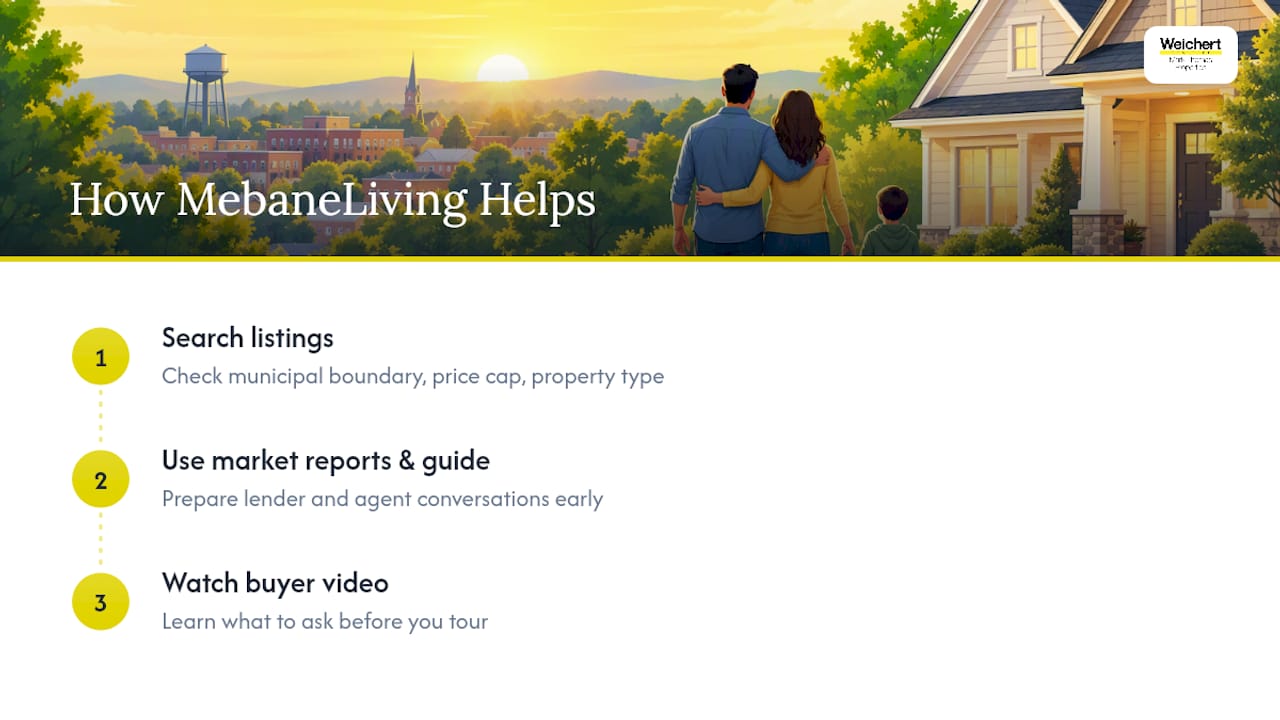
Searchable listings and filters can help you check a property's municipal boundary, price cap, and property type before you fall in love with it. Our market reports and buyer guide walk you through starting lender and agent conversations early, and our buyer video covers what to ask before you tour. Start your search with homes for sale in Mebane.
Assistance makes sense when it closes a real down-payment gap, you plan to stay long enough to reach forgiveness, or tight credit makes a larger down payment unrealistic otherwise. If flexibility to sell or refinance soon matters more to you, saving longer and coordinating with a lender early usually serves you better.
— Chelsea
Figuring out whether a property qualifies for Durham's, Raleigh's, or NCHFA's programs shouldn't require guesswork or a dozen phone calls. That's exactly where MebaneLiving fits in: our platform pairs local listings with the market knowledge to flag municipal boundaries and price caps before you fall for a house that turns out to be outside the zone.

If you're weighing whether a home fits your budget against a program's sales-price cap, request a Free Home Value Walkthrough (CMA) and we'll pull comparable sales for you at no cost. Ready to start the process for real? Our buying resources walk you through preapproval and connect you with lenders who already work with NC's DPA programs, and you can browse current inventory anytime through homes for sale in Mebane.
Before you rely on any figure in this article, confirm current terms directly: the NCHFA program page, Durham's DPA page, Raleigh's homebuyer assistance page, HUD's homebuying resources, and ReBuild NC's homeownership assistance program. Funds run out. Ask your lender to confirm current allocations before you write an offer.
It depends entirely on the home price and loan type, since $30,000 might cover a full 20% down payment on a $150,000 home or a small fraction of a down payment on a $400,000 one. Pairing that amount with an NCHFA subordinate loan or a city program like Durham's up to $80,000 DPA can stretch your buying power considerably further.
Yes, NCHFA continues to offer the NC Home Advantage Mortgage with its 3% down payment assistance option and the separate $15,000 NC 1st Home Advantage Down Payment for qualifying first-time buyers and veterans. Availability and income limits are set annually, so confirm current terms with a participating lender.
The assistance is usually a lien, not a gift, so selling or refinancing before the forgiveness period ends can trigger repayment of the unforgiven balance. Buyers who don't plan to stay in the home long enough often end up owing money back at closing.
Programs like New Jersey's grant options are specific to that state and don't apply to North Carolina buyers. If you're purchasing in North Carolina, your comparable options are the statewide NCHFA programs and municipal programs like Durham's or Raleigh's, each with its own income limits and application process.
Mebaneliving doesn't process DPA applications directly, since that runs through participating lenders and the housing agencies themselves. We help by confirming whether a property sits inside the right municipal boundary and price cap, and by connecting you with lenders and agents who already work with these programs through our buyer guide.

Hi there! I’m Chelsea Vanderpool, a Property Manager and licensed real estate referral agent as well as team player with Sam Paynter for buying and selling with Weichert REALTORS®, Mark Thom....
Yes, North Carolina levies an excise tax of $1 for every $500 (or fraction of $500) of the property's value. This tax applies statewide under Article 8E of the North Carolina General Statutes, and
North Carolina's main down payment assistance options are the NCHFA 3% DPA and the $15,000 NC 1st Home Advantage, both paired with the NC Home Advantage Mortgage, plus city programs like Durham's
A coming soon listing is a home that's headed to market, usually within 30 days, but isn't officially active yet. That window gives buyers a rare head start: less competition, more time to plan, and
"Active under contract" means the seller has accepted an offer, but contingencies like inspection or financing are still being worked out, so the home stays on the market. Buyers can usually still
 Copyright 2026 Triangle MLS, Inc. of North Carolina. All rights reserved.
The data relating to real estate for sale on this web site comes in part from the Triangle MLS, Inc. of North Carolina. Real estate listings held by brokerage firms other than Weichert, Realtors® - Mark Thomas Properties - Durham are marked with the Broker Reciprocity logo and detailed information about them includes the name of the listing brokers. Brokers make an effort to deliver accurate information, but buyers should independently verify any information on which they will rely in a transaction. The listing broker shall not be responsible for any typographical errors, misinformation, or misprints, and they shall be held totally harmless from any damages arising from reliance upon this data. This data is provided exclusively for consumer's personal, noncommercial use.
Closed (sold) listings may have been listed and/or sold by a real estate firm other than the firm(s) featured on this website. Closed data is not available until the sale of the property is recorded in the MLS. Home sale data is not an appraisal, CMA, competitive or comparative market analysis, or home valuation of any property.
Listings marked with an icon are provided courtesy of the Triangle MLS, Inc. of North Carolina, Internet Data Exchange Database.
This site is monitored for scraping. Any use of listing data obtained from this web site, other than by a consumer looking to purchase real estate, is prohibited.
This data has been updated as of September 25, 2026 8:22 PM UTC
Copyright 2026 Triangle MLS, Inc. of North Carolina. All rights reserved.
The data relating to real estate for sale on this web site comes in part from the Triangle MLS, Inc. of North Carolina. Real estate listings held by brokerage firms other than Weichert, Realtors® - Mark Thomas Properties - Durham are marked with the Broker Reciprocity logo and detailed information about them includes the name of the listing brokers. Brokers make an effort to deliver accurate information, but buyers should independently verify any information on which they will rely in a transaction. The listing broker shall not be responsible for any typographical errors, misinformation, or misprints, and they shall be held totally harmless from any damages arising from reliance upon this data. This data is provided exclusively for consumer's personal, noncommercial use.
Closed (sold) listings may have been listed and/or sold by a real estate firm other than the firm(s) featured on this website. Closed data is not available until the sale of the property is recorded in the MLS. Home sale data is not an appraisal, CMA, competitive or comparative market analysis, or home valuation of any property.
Listings marked with an icon are provided courtesy of the Triangle MLS, Inc. of North Carolina, Internet Data Exchange Database.
This site is monitored for scraping. Any use of listing data obtained from this web site, other than by a consumer looking to purchase real estate, is prohibited.
This data has been updated as of September 25, 2026 8:22 PM UTC
