
A coming soon listing is a home that's headed to market, usually within 30 days, but isn't officially active yet. That window gives buyers a rare head start: less competition, more time to plan, and


Dated: September 22 2026
Views: 1
"Active under contract" means the seller has accepted an offer, but contingencies like inspection or financing are still being worked out, so the home stays on the market. Buyers can usually still submit backup offers, and sellers should know they cannot walk away from a signed contract just because a better one shows up later.
TL;DR:
- Active under contract listings commonly remain available for backup offers until contingencies like financing or inspection are resolved, typically lasting 30 to 60 days.
- Buyers should strengthen backup offers by securing pre-approval, reducing contingencies, and working through agents to confirm acceptance before submitting formal proposals.
- The key difference from pending status is that active under contract still allows showings and backup offers; pending indicates contingencies have been satisfied and the deal is near closing.
- The sale can fall apart mainly due to financing, inspection, or appraisal issues, making timely contingency management critical for buyers and sellers.
- Local market trends influence how long listings stay active under contract, with faster markets often shortening contingency deadlines and closing times.
The RESO data dictionary treats "Active Under Contract" as an official standard status: an accepted offer where the listing still shows as active on the market. RESO also lists "Accepting Backup Offers" and "Backup Offer" as recognized synonyms, which is why you'll sometimes see slightly different wording depending on which MLS or portal you're browsing.
Listing agents keep a home in this status for a practical reason. If the buyer's financing falls through or the inspection turns up a deal-breaker, the seller doesn't want to start over from zero. Chase's explainer on the topic confirms this: keeping the listing visible protects the seller's momentum and gives them a running start on backup buyers if the current contract collapses.
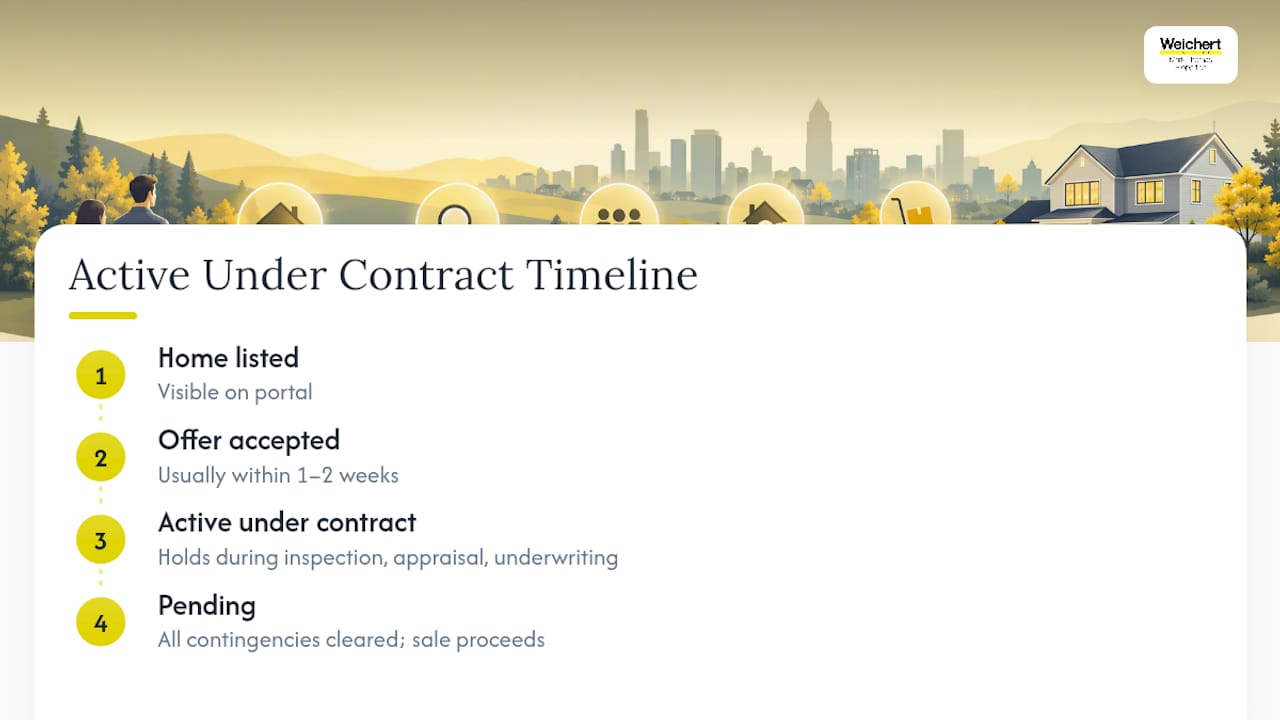
Here's a rough timeline of how that plays out on a typical portal: a home lists, an offer gets accepted within a week or two, the status flips to "active under contract," and it holds there through inspection, appraisal, and loan underwriting. Only once every contingency clears does the status usually shift to "pending."
One thing worth remembering: MLS terminology isn't universal. Some regional systems display "active under contract," others use "under contract, accepting backup offers," and a few skip straight to a pending flag once an offer lands. If you're not sure what a specific listing's status actually allows, the fastest path to clarity is calling the listing agent directly.
These four labels get used almost interchangeably by buyers scrolling listings, but they describe different levels of risk that the deal actually closes.
The real differentiator across all four is contingency status. A listing marked "active under contract" is still a live opportunity for a backup offer because the buyer hasn't cleared every hurdle yet. Once it flips to "pending," the seller and buyer are typically headed toward a "clear to close" milestone, and jumping in as a new bidder becomes far less realistic. Watching whether showings are still permitted is often your fastest clue: active listings under contract frequently keep the door open for tours, while pending listings usually shut them down.
Yes, in most cases. Rocket Mortgage's explainer confirms that buyers can typically submit backup offers on active-under-contract listings, but that offer only becomes enforceable if the original contract falls apart under its own terms. Sellers can accept a backup, but they cannot legally break a valid signed contract just because your offer looks better on paper.
If you want to position yourself well as a backup buyer, a few moves matter:
Several contingencies commonly keep a sale in this holding pattern:
Most deals sit in "active under contract" for somewhere between 30 and 60 days, though that window shifts with contract deadlines and how fast the local market is moving, according to Zillow's guidance. Individual contingency deadlines often run 7 to 30 days each, and hot markets frequently shorten those windows contractually to keep deals moving faster.
Financing, inspection, and appraisal issues are the most common reasons deals in this status fall apart, per Zillow's analysis, which is exactly why smart sellers keep the listing active and smart buyers keep a backup offer polished and ready.
If you're the buyer:
If you're the seller:
Buyers preparing financing paperwork should also check current mortgage lender options in North Carolina before submitting a backup offer, since a stronger preapproval letter is often the single biggest lever you control.
Pro Tip: Ask the listing agent one specific question: "What contingency is still outstanding, and what's the deadline?" The answer tells you more about the deal's real fragility than the status label ever will.
For a deeper look at how contingent and pending statuses differ on the ground in this market, see this breakdown of contingent vs pending listings.
Agents rarely treat "active under contract" as a formality. In a fast-moving market, a listing agent might keep showings running hard for the first two weeks of a contingency period simply because they've seen financing fall through often enough to want a strong bench of backups. In a slower market, that same agent might quietly pause showings once an offer is accepted, betting the contingencies will clear without drama.
Local market reports matter here more than people realize. Reviewing Alamance County market trends or Durham County market trends tells you how quickly homes in a specific area are typically clearing contingencies, which helps you judge whether a backup offer is worth the wait or whether you're better off moving on to a fresh listing.
— Chelsea
Mebane Living gives you something a status label alone never will: a local read on whether that "active under contract" home is actually worth pursuing as a backup, or whether your time is better spent elsewhere. Start by browsing homes for sale in Mebane to see what else is realistically available while you wait out a contingency period.

If you're the buyer weighing a backup offer, our buyer's guide walks through exactly how to strengthen your position, and a short video walkthrough covers the same ground if you'd rather watch than read. Sellers deciding how to handle a current contract and any backup offers can start with our free, no-obligation comparison of selling options, or request a Free Home Value Walkthrough to confirm your home is priced to hold up if the first deal falls through. Reach out to a local agent this week to get a straight answer on where a specific active-under-contract listing actually stands.
Most listings hold this status for roughly 30 to 60 days, depending on how quickly financing, inspection, and appraisal contingencies clear. Faster markets and shorter contract deadlines can move that timeline down significantly.
"Under contract" (including "active under contract") means contingencies are still open and the listing may still accept backup offers. "Pending" means those contingencies have cleared and the deal is heading toward closing, usually with showings paused.
Yes, you can typically submit a backup offer on a home listed as active under contract. That backup offer only becomes enforceable if the original contract terminates under its own terms, so confirm with the listing agent that backups are being accepted first.
It depends entirely on the contract's contingency deadlines, which often run 7 to 30 days each for financing, inspection, and appraisal steps. Once every contingency clears or gets waived, the status typically shifts to pending within days.

Hi there! I’m Chelsea Vanderpool, a Property Manager and licensed real estate referral agent as well as team player with Sam Paynter for buying and selling with Weichert REALTORS®, Mark Thom....
A coming soon listing is a home that's headed to market, usually within 30 days, but isn't officially active yet. That window gives buyers a rare head start: less competition, more time to plan, and
"Active under contract" means the seller has accepted an offer, but contingencies like inspection or financing are still being worked out, so the home stays on the market. Buyers can usually still
Most buyers should plan on an earnest money amount between 1% and 3% of the purchase price, with 5% or more common in competitive markets or on luxury contracts. That deposit gets credited toward
North Carolina caps security deposits at specific maximum amounts based on tenancy type: shorter tenancies have lower limits, and leases longer than month-to-month have a higher maximum deposit.
 Copyright 2026 Triangle MLS, Inc. of North Carolina. All rights reserved.
The data relating to real estate for sale on this web site comes in part from the Triangle MLS, Inc. of North Carolina. Real estate listings held by brokerage firms other than Weichert, Realtors® - Mark Thomas Properties - Durham are marked with the Broker Reciprocity logo and detailed information about them includes the name of the listing brokers. Brokers make an effort to deliver accurate information, but buyers should independently verify any information on which they will rely in a transaction. The listing broker shall not be responsible for any typographical errors, misinformation, or misprints, and they shall be held totally harmless from any damages arising from reliance upon this data. This data is provided exclusively for consumer's personal, noncommercial use.
Closed (sold) listings may have been listed and/or sold by a real estate firm other than the firm(s) featured on this website. Closed data is not available until the sale of the property is recorded in the MLS. Home sale data is not an appraisal, CMA, competitive or comparative market analysis, or home valuation of any property.
Listings marked with an icon are provided courtesy of the Triangle MLS, Inc. of North Carolina, Internet Data Exchange Database.
This site is monitored for scraping. Any use of listing data obtained from this web site, other than by a consumer looking to purchase real estate, is prohibited.
This data has been updated as of September 22, 2026 5:18 PM UTC
Copyright 2026 Triangle MLS, Inc. of North Carolina. All rights reserved.
The data relating to real estate for sale on this web site comes in part from the Triangle MLS, Inc. of North Carolina. Real estate listings held by brokerage firms other than Weichert, Realtors® - Mark Thomas Properties - Durham are marked with the Broker Reciprocity logo and detailed information about them includes the name of the listing brokers. Brokers make an effort to deliver accurate information, but buyers should independently verify any information on which they will rely in a transaction. The listing broker shall not be responsible for any typographical errors, misinformation, or misprints, and they shall be held totally harmless from any damages arising from reliance upon this data. This data is provided exclusively for consumer's personal, noncommercial use.
Closed (sold) listings may have been listed and/or sold by a real estate firm other than the firm(s) featured on this website. Closed data is not available until the sale of the property is recorded in the MLS. Home sale data is not an appraisal, CMA, competitive or comparative market analysis, or home valuation of any property.
Listings marked with an icon are provided courtesy of the Triangle MLS, Inc. of North Carolina, Internet Data Exchange Database.
This site is monitored for scraping. Any use of listing data obtained from this web site, other than by a consumer looking to purchase real estate, is prohibited.
This data has been updated as of September 22, 2026 5:18 PM UTC
