
A coming soon listing is a home that's headed to market, usually within 30 days, but isn't officially active yet. That window gives buyers a rare head start: less competition, more time to plan, and


Dated: September 21 2026
Views: 6

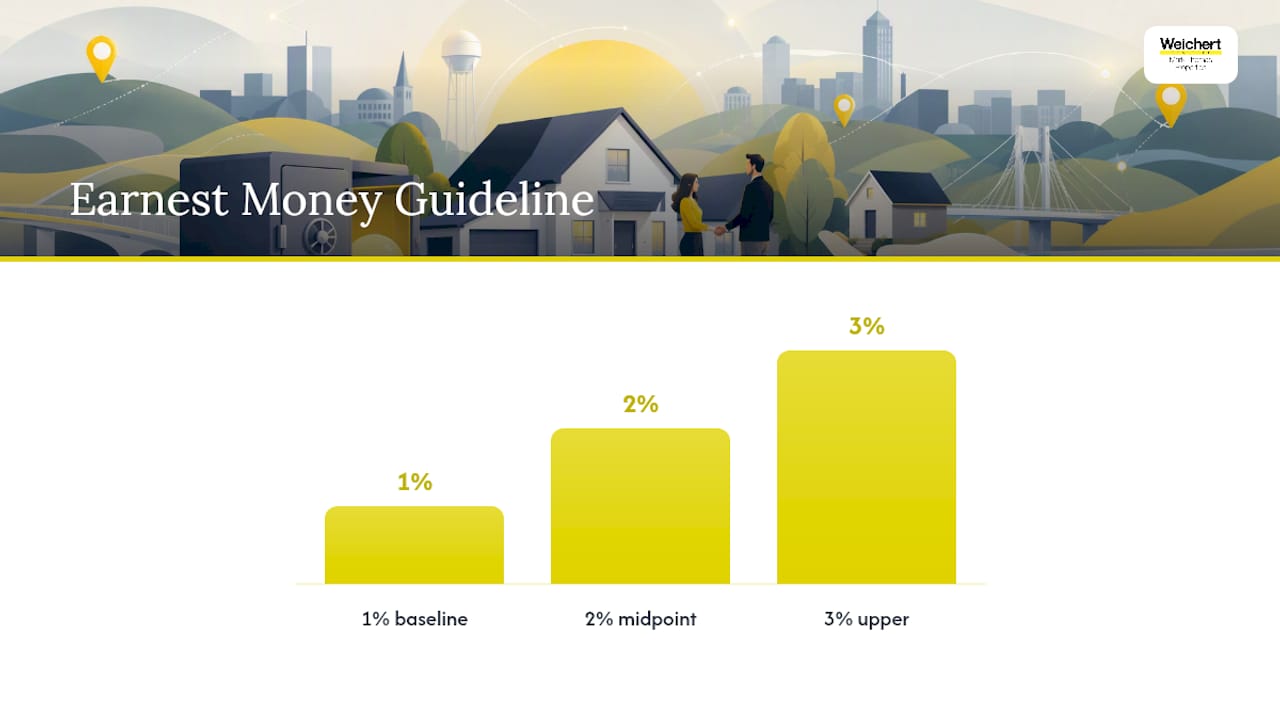
Most buyers should plan on an earnest money amount between 1% and 3% of the purchase price, with 5% or more common in competitive markets or on luxury contracts. That deposit gets credited toward your down payment or closing costs at closing, and it stays refundable as long as your contract's contingencies protect you. The National Association of Realtors and HUD's FHA guidelines both back that range, and local market data indicates it holds true across Alamance and Durham counties, too.
TL;DR:
- Buyers in most markets should plan on an earnest money deposit of 1% to 3% of the purchase price, with higher amounts of 5% or more common in competitive or luxury markets.
- Larger deposits of 3% to 10% are typically expected in high-demand situations, such as multiple offers or high-end listings, signaling buyer seriousness.
- Earnest money is held in escrow by a third party, and refunds are granted if contingencies like inspections or financing issues are met; otherwise, sellers may keep the deposit.
- FHA lenders require documentation for deposits over 1% of the purchase price, with builders and luxury properties often setting higher or staged deposit requirements.
- Local customs vary, but buyers should consult agents to determine the appropriate amount, aiming for a balance between competitiveness and safety, and verify escrow procedures to avoid wire fraud.
The 1% to 3% band shows up in guidance from the National Association of Realtors and from lenders like Wells Fargo, who describe earnest money as a good-faith deposit that gets applied to your closing costs later. In some regions, though, agents and sellers still expect a flat dollar figure rather than a percentage, especially on homes priced under $300,000. You'll see $1,000, $2,500, or $5,000 requested regardless of the sale price in those markets, according to consumer lending guides.
Dollar amounts make the percentages easier to picture. Here's what 1%, 2%, and 3% look like at a few common price points:
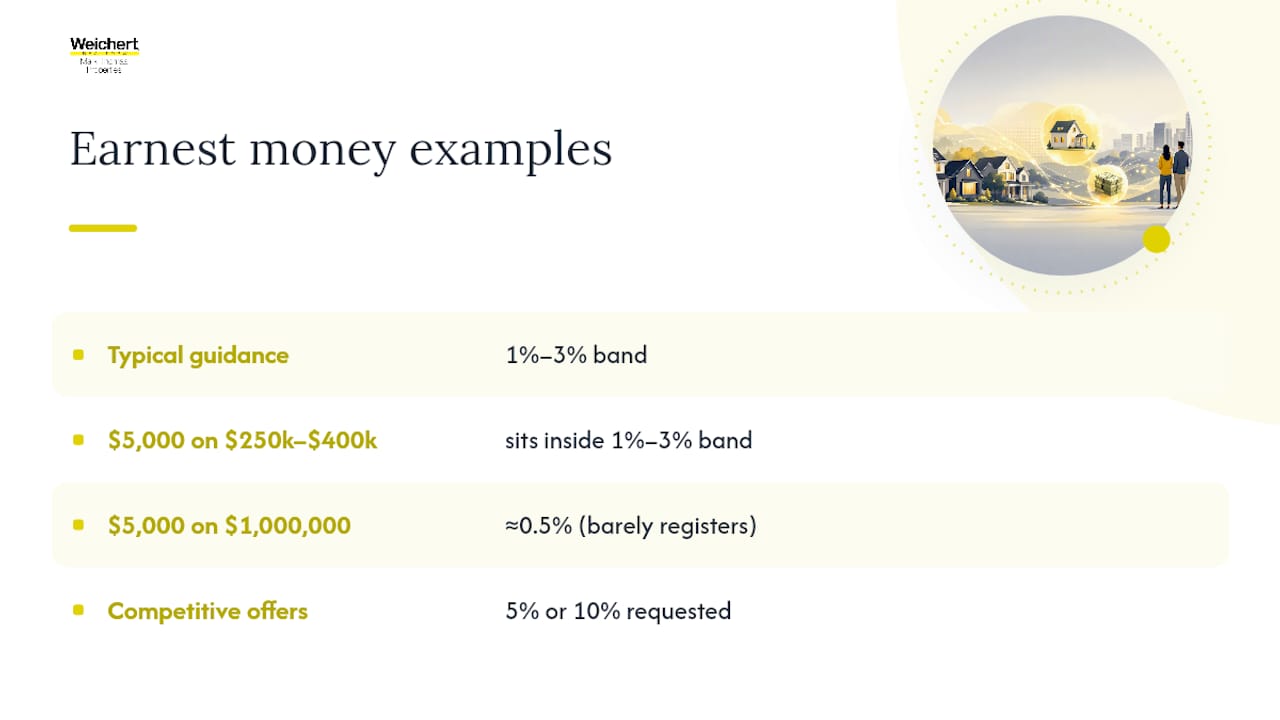
On a $400,000 house, the typical earnest money deposit lands within a few thousand dollars, reflecting the 1% to 3% range commonly seen. Is $5,000 enough? On a home in the $250,000 to $400,000 range, yes, it sits comfortably inside the standard band. On a $1 million property, $5,000 barely registers as half a percent, which won't impress a seller in a hot market.
In competitive bidding situations or on high-end listings, AmeriSave's guidance notes offers routinely climb to 5% or 10% of the purchase price. That's a signal of seriousness sellers notice fast when they're juggling multiple offers.
Market conditions do more to move your earnest money number than any rule of thumb. A seller's market with multiple offers on the table calls for a stronger deposit than a quiet buyer's market where you're the only one at the table.
A few factors that push your number up or down:
The NAR's guidance points out that builders often treat deposits differently from resale sellers, sometimes without the same escrow protections. Read new-construction contracts closely before you sign, and compare that against how new construction pricing differs from resale before you commit funds.
Your earnest money doesn't go to the seller. It goes into escrow, held by a title company, real estate brokerage, or attorney, depending on your state's customs. Buyers typically have one to three days after the contract is signed to deliver the funds, usually by wire transfer or certified check.
At closing, that deposit gets credited toward your down payment or closing costs, effectively shrinking the check you write on closing day. If the deal falls apart for a reason your contract protects, you get the money back.
Contingencies that typically preserve your refund include:
Sellers can keep earnest money when a buyer backs out for a reason outside those protections, such as simple cold feet or missing a contractual deadline. Roughly one in three real estate contracts nationally includes some form of dispute over deposit handling when contingencies aren't spelled out clearly, according to NAR's overview of earnest money disputes. Document every refund trigger in writing, and keep your wire confirmation and escrow receipt somewhere you can find them fast.
FHA loans come with a specific paperwork trigger. Under HUD Handbook 4000.1, lenders must verify and document the source of any earnest money deposit that exceeds 1% of the sales price. If a relative gifted you the funds, you'll need a formal gift letter, or your underwriting can stall right when you need it to move fast.
A few other exceptions worth knowing before you write an offer:
Ask for the escrow terms in writing before you sign anything on a new-construction deal.
Getting the number right takes a few conversations, not guesswork. Work through this sequence with your agent before you write an offer:
Before you submit an offer, ask your agent or title company these questions: Who holds the deposit? What's the delivery deadline? What contingencies protect my refund? Is a gift letter required? Does the seller's market favor a higher deposit? What's the escrow company's wiring verification process? Are there staged deposit options here?
Pro Tip: Round your earnest money to a clean number like $10,000 instead of an oddly specific figure like $9,842. Sellers read round numbers as more decisive, and it barely changes your math.
Local custom shapes earnest money more than any national average, and Central North Carolina has its own rhythm.
Our Alamance County Market Trends report and Durham County Market Trends report track exactly this kind of shift month to month.
A few things we tell buyers before they write an offer here:
A first-time buyer offering on a $350,000 Mebane home might reasonably start at 1.5% ($5,250), then raise to 3% only if a bidding war develops.
It isn't.
What gets overlooked most: sellers read your deposit as a signal of seriousness, not just as a contract line item. On the flip side, over-committing on a slow listing wastes leverage you didn't need to give up.
Prioritize the conversation with your agent about hyperlocal norms before you calculate anything. The percentage matters less than matching what similar buyers just did on similar homes down the street.
— Chelsea

Pair that with our buying a home resources, which connect you with a local agent who tracks earnest money customs street by street, plus mortgage pre-approval help so your financing and your deposit strategy line up before you write an offer. Ready to see what's available? Browse homes for sale in Mebane and reach out to start the conversation with a local agent this week.
For deeper detail, review the NAR's earnest money overview, HUD Handbook 4000.1, and Mebaneliving's county market reports above.
This article is general information, not a substitute for advice from a qualified financial advisor. Consult a qualified financial professional about your own circumstances before acting on anything here.
In competitive bidding situations, buyers may consider offering a higher deposit to strengthen their bid.
Yes, 1% sits at the low end of the typical national range and works fine in slower markets with little competition.
Local custom and market competition determine where in that range your offer should sit.
On a home priced between $250,000 and $400,000, $5,000 falls within the standard percentage range and works fine in most markets.
You typically get earnest money back when a contingency in your contract, like a failed inspection, financing falling through, or a low appraisal, gives you a documented exit. Funds are usually returned by the escrow holder within a few business days of the contingency being triggered in writing.

Hi there! I’m Chelsea Vanderpool, a Property Manager and licensed real estate referral agent as well as team player with Sam Paynter for buying and selling with Weichert REALTORS®, Mark Thom....
A coming soon listing is a home that's headed to market, usually within 30 days, but isn't officially active yet. That window gives buyers a rare head start: less competition, more time to plan, and
"Active under contract" means the seller has accepted an offer, but contingencies like inspection or financing are still being worked out, so the home stays on the market. Buyers can usually still
Most buyers should plan on an earnest money amount between 1% and 3% of the purchase price, with 5% or more common in competitive markets or on luxury contracts. That deposit gets credited toward
North Carolina caps security deposits at specific maximum amounts based on tenancy type: shorter tenancies have lower limits, and leases longer than month-to-month have a higher maximum deposit.
 Copyright 2026 Triangle MLS, Inc. of North Carolina. All rights reserved.
The data relating to real estate for sale on this web site comes in part from the Triangle MLS, Inc. of North Carolina. Real estate listings held by brokerage firms other than Weichert, Realtors® - Mark Thomas Properties - Durham are marked with the Broker Reciprocity logo and detailed information about them includes the name of the listing brokers. Brokers make an effort to deliver accurate information, but buyers should independently verify any information on which they will rely in a transaction. The listing broker shall not be responsible for any typographical errors, misinformation, or misprints, and they shall be held totally harmless from any damages arising from reliance upon this data. This data is provided exclusively for consumer's personal, noncommercial use.
Closed (sold) listings may have been listed and/or sold by a real estate firm other than the firm(s) featured on this website. Closed data is not available until the sale of the property is recorded in the MLS. Home sale data is not an appraisal, CMA, competitive or comparative market analysis, or home valuation of any property.
Listings marked with an icon are provided courtesy of the Triangle MLS, Inc. of North Carolina, Internet Data Exchange Database.
This site is monitored for scraping. Any use of listing data obtained from this web site, other than by a consumer looking to purchase real estate, is prohibited.
This data has been updated as of September 22, 2026 5:18 PM UTC
Copyright 2026 Triangle MLS, Inc. of North Carolina. All rights reserved.
The data relating to real estate for sale on this web site comes in part from the Triangle MLS, Inc. of North Carolina. Real estate listings held by brokerage firms other than Weichert, Realtors® - Mark Thomas Properties - Durham are marked with the Broker Reciprocity logo and detailed information about them includes the name of the listing brokers. Brokers make an effort to deliver accurate information, but buyers should independently verify any information on which they will rely in a transaction. The listing broker shall not be responsible for any typographical errors, misinformation, or misprints, and they shall be held totally harmless from any damages arising from reliance upon this data. This data is provided exclusively for consumer's personal, noncommercial use.
Closed (sold) listings may have been listed and/or sold by a real estate firm other than the firm(s) featured on this website. Closed data is not available until the sale of the property is recorded in the MLS. Home sale data is not an appraisal, CMA, competitive or comparative market analysis, or home valuation of any property.
Listings marked with an icon are provided courtesy of the Triangle MLS, Inc. of North Carolina, Internet Data Exchange Database.
This site is monitored for scraping. Any use of listing data obtained from this web site, other than by a consumer looking to purchase real estate, is prohibited.
This data has been updated as of September 22, 2026 5:18 PM UTC
