
Cap rate equals net operating income divided by property value, expressed as a percentage. It measures the unlevered annual yield a property produces, ignoring financing, which makes it a fast way


Dated: September 19 2026
Views: 2
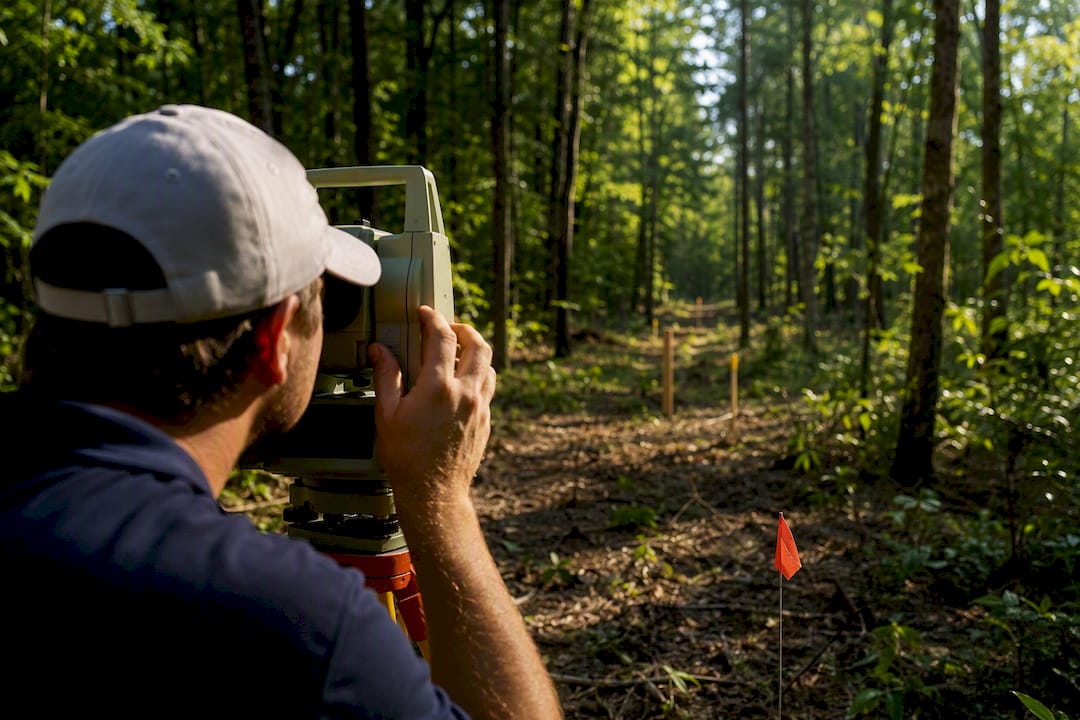
A standard residential boundary survey in North Carolina typically runs $500 to $1,800, while ALTA, topographic, mountain-lot, and large-acreage surveys often climb into the thousands. Pull your deed and any prior plat now, then request two or three written quotes from a licensed Professional Land Surveyor before you commit to one.
TL;DR:
- Boundary surveys for residential lots in North Carolina typically cost between $400 and $1,500, depending on parcel complexity and documentation accuracy.
- ALTA/NSPS surveys and large acreage projects generally run into thousands, driven by the need for title research, precise Table A requirements, and site-specific challenges.
- Costs are higher in mountain or rural areas due to terrain, difficult access, and longer travel times, with regional prices also influenced by local record availability and labor rates.
- Obtaining at least two written quotes before hiring can help homeowners manage expectations, as site-specific factors significantly affect final pricing.
- Expect additional fees for travel, rush service, recording, permits, and specialized deliverables, which can substantially increase the base cost depending on the scope and timeline.
The price tag depends almost entirely on what you're asking the surveyor to produce. A simple boundary survey answers "where are my property lines?" An ALTA/NSPS survey answers that question plus a dozen others a lender or title company might ask. Here's how the typical categories break down statewide.
| Survey type | Typical NC cost range | What it delivers |
|---|---|---|
| Boundary/property survey | $400 to $1,500+ | Marks legal property corners and lines |
| ALTA/NSPS survey | Low thousands and up | Title-grade survey with lender/insurer requirements |
| Topographic survey | $500 to $1,800 | Elevation contours and site features for design work |
| Elevation certificate | $300 to $800 or more | Flood-zone elevation data for insurance purposes |
| Acreage/rural land survey | Varies by acreage and terrain | Boundary work across larger, often unplatted tracts |
A few things drive that spread beyond square footage, as explained in this construction surveying field guide:
Most surveyors quote a flat fee for straightforward residential lots and switch to hourly or per-acre billing once a parcel gets large, wooded, or legally messy. If your quote comes back hourly, ask for a not-to-exceed cap so the number doesn't drift.
Two lots of identical acreage can carry wildly different quotes, and the reason almost always traces back to one of four variables.
Add-ons stack on top of the base fee too: permit-review documentation, rush turnaround, and deliverables like CAD files, recordable plats, or physical corner staking each carry their own line item.
Pro Tip: Ask upfront whether the quote includes a recorded plat and physical stakeout, since some surveyors treat those as separate charges that can add several hundred dollars to what looked like a lower bid.
Yes, and the gap between a Piedmont subdivision lot and a mountain acreage tract can be substantial. Regional price differences track terrain, records availability, and local labor costs, which is consistent with how the Bureau of Economic Analysis explains price variation across US metro areas generally.
Getting a number you can trust starts with giving the surveyor everything they need before they ever visit the site.
A few habits separate a smooth process from a frustrating one:
Real estate advice often recommends ordering your survey during due diligence, not after. A boundary problem discovered post closing is a legal headache; one caught during the option period is just paperwork. Sellers benefit from the same logic in reverse, resolving fence-line or encroachment questions before a buyer's lender flags them.
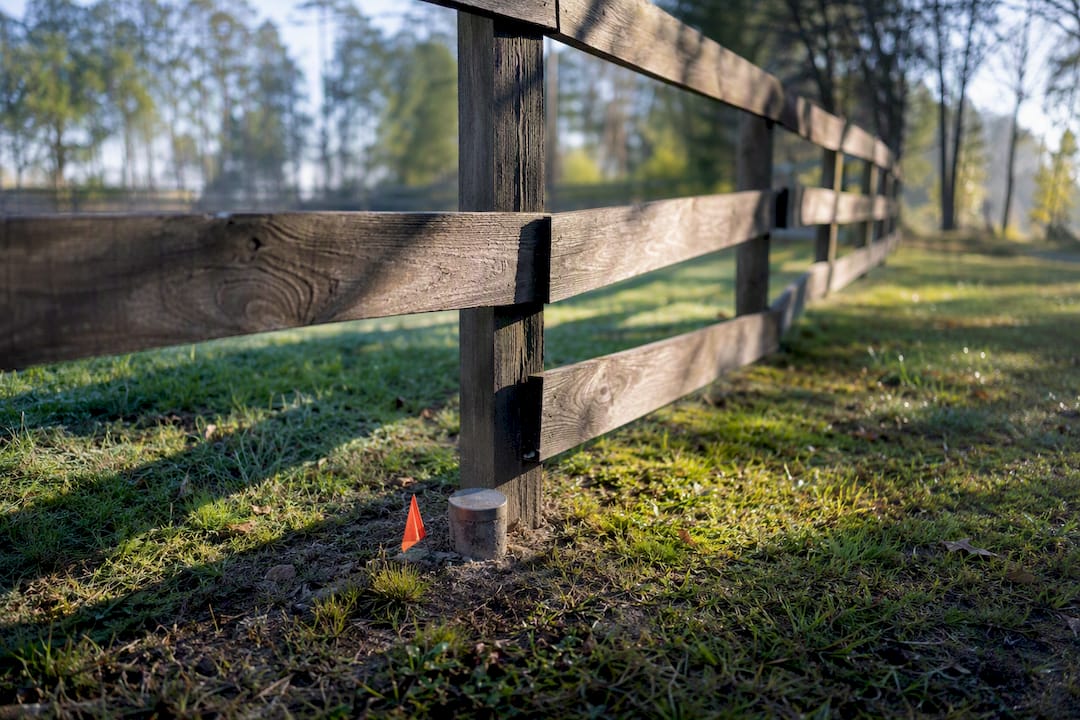
Timing matters for closing, too, since permitting offices in Central NC often want a current survey before approving additions or subdivisions. If you're weighing whether to buy in this market, our buyer's guide walks through where survey costs fit into your overall budget, and our monthly Alamance County market report gives context on what's moving locally.
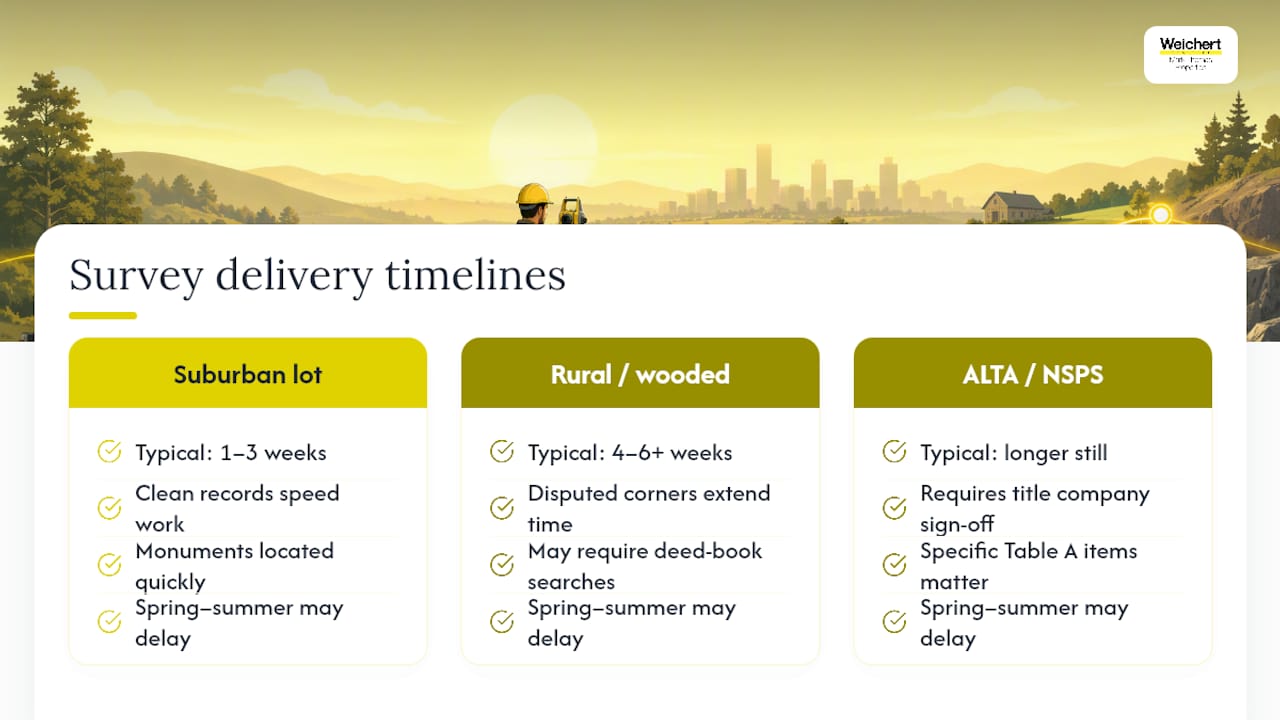
Most residential boundary surveys in North Carolina take one to three weeks from the day you hire the surveyor to the day you get the finished plat, though that window shifts based on backlog and complexity. Simple platted suburban lots with clean records move faster since the crew can locate existing monuments quickly and spend less time in the office.
Rural acreage, wooded tracts, or parcels with disputed corners stretch that timeline to four to six weeks or longer, particularly when the surveyor has to search historical deed books at the county Register of Deeds. ALTA/NSPS surveys almost always take longer still because they require title company coordination and sign off on specific Table A requirements before the final product goes out.
Busy season adds another variable. Spring and summer, when home sales and construction both pick up across Central NC, tend to push surveyor calendars out further than a slow winter month would. If your closing date is firm, ask the surveyor for a specific delivery date in writing rather than a general estimate, and build in a buffer of at least a week for revisions if the title company or lender requests changes to the plat.
The number on your initial quote rarely tells the whole story. Travel fees show up when a surveyor has to drive well outside their normal service area, which is common for rural acreage or mountain parcels far from the nearest crew base. Administrative costs, sometimes bundled and sometimes itemized separately, cover courthouse research, recording fees at the Register of Deeds, and the time spent preparing the final report.
Rush fees apply if you need the survey turned around faster than the surveyor's normal schedule allows, and that markup can add a meaningful percentage to the base cost. Report fees or extra certified copies of the plat sometimes carry a small charge too, especially if your lender or title company needs multiple signed originals.
Since labor typically makes up 60 to 80 percent of a survey's total cost, anything that adds crew hours (travel, difficult terrain, extra research) shows up directly in your final invoice. Ask every surveyor you quote to itemize these potential extras upfront so you're comparing full totals, not just base fees.
Most advice on this topic treats "how much does a survey cost" as a single number to memorize, and that's the wrong way to think about it. The real skill is diagnosing which cost drivers apply to your specific parcel, since a flat platted quarter-acre in a Mebane subdivision and a wooded five-acre tract outside Roxboro aren't the same purchase even if both get called a "boundary survey."
The conventional advice to "just get a quote" also undersells how much a little prep work changes that number. Handing a surveyor your deed, a prior survey, and a title report before they even schedule the site visit routinely trims research hours off the bill. Most homeowners skip this step and pay for it.
If I had to prioritize one thing for Central NC buyers and sellers, it's this: don't wait until the week before closing to think about your survey. Order it early enough that a boundary surprise becomes a negotiation point instead of a closing-day emergency.
— Chelsea
Mebaneliving gives Central North Carolina buyers and sellers a direct line to local pricing knowledge instead of a generic national estimate, connecting survey and closing-cost questions to the actual market data for Durham, Mebane, and Roxboro.

If you're budgeting for a purchase, our free buyer's guide walks through where survey costs land in your overall closing budget, and our buying a home resource covers what to expect during due diligence. Selling instead, and wondering whether a boundary issue is worth resolving before you list? Start with our free, no-obligation comparison of your selling options or grab a free Home Value Walkthrough to see where your property stands before you invest in a survey. Ready to see what's on the market right now? Browse homes for sale in Mebane and reach out when you're ready to talk through next steps.
For deeper cost breakdowns, see the statewide North Carolina survey cost guide and the boundary survey pricing guide. Verify any surveyor's license through the North Carolina Board of Examiners for Engineers and Surveyors, and check historical deeds through your county Register of Deeds.
A basic boundary survey on a small, platted lot with clear records and easy access is typically the least expensive option, often falling near the low end of the $400 to $1,500 range. Elevation certificates can sometimes cost less as a standalone product if a boundary survey isn't also required.
Yes, in most purchase scenarios a survey protects you from boundary disputes, encroachments, and title issues that can surface after closing. Ordering it during due diligence, as covered in our buyer's guide, gives you leverage to negotiate or walk away before you're locked into the purchase.
No. Legal boundary surveys in North Carolina must be performed by a licensed Professional Land Surveyor, and a self-made measurement carries no legal standing with lenders, title companies, or the county. Always verify a surveyor's license before hiring them.
There's no single fixed number, since per-acre cost tends to drop as acreage increases while total project cost still rises with size and terrain complexity. A wooded or unplatted tract with limited records will cost meaningfully more than a flat, well-documented parcel of the same size, so getting a written quote based on your specific property is the only reliable way to know.

Hi there! I’m Chelsea Vanderpool, a Property Manager and licensed real estate referral agent as well as team player with Sam Paynter for buying and selling with Weichert REALTORS®, Mark Thom....
Cap rate equals net operating income divided by property value, expressed as a percentage. It measures the unlevered annual yield a property produces, ignoring financing, which makes it a fast way
A standard residential boundary survey in North Carolina typically runs $500 to $1,800, while ALTA, topographic, mountain-lot, and large-acreage surveys often climb into the thousands. Pull
A triple net (NNN) lease requires the tenant to pay base rent plus property taxes, building insurance, and maintenance costs (CAM). Landlords like the arrangement because it delivers predictable net
For most North Carolina homeowners, American Home Shield is the strongest overall pick thanks to its generous HVAC caps and openness to older systems, a big deal in a state where humidity runs hard
 Copyright 2026 Triangle MLS, Inc. of North Carolina. All rights reserved.
The data relating to real estate for sale on this web site comes in part from the Triangle MLS, Inc. of North Carolina. Real estate listings held by brokerage firms other than Weichert, Realtors® - Mark Thomas Properties - Durham are marked with the Broker Reciprocity logo and detailed information about them includes the name of the listing brokers. Brokers make an effort to deliver accurate information, but buyers should independently verify any information on which they will rely in a transaction. The listing broker shall not be responsible for any typographical errors, misinformation, or misprints, and they shall be held totally harmless from any damages arising from reliance upon this data. This data is provided exclusively for consumer's personal, noncommercial use.
Closed (sold) listings may have been listed and/or sold by a real estate firm other than the firm(s) featured on this website. Closed data is not available until the sale of the property is recorded in the MLS. Home sale data is not an appraisal, CMA, competitive or comparative market analysis, or home valuation of any property.
Listings marked with an icon are provided courtesy of the Triangle MLS, Inc. of North Carolina, Internet Data Exchange Database.
This site is monitored for scraping. Any use of listing data obtained from this web site, other than by a consumer looking to purchase real estate, is prohibited.
This data has been updated as of September 19, 2026 2:22 PM UTC
Copyright 2026 Triangle MLS, Inc. of North Carolina. All rights reserved.
The data relating to real estate for sale on this web site comes in part from the Triangle MLS, Inc. of North Carolina. Real estate listings held by brokerage firms other than Weichert, Realtors® - Mark Thomas Properties - Durham are marked with the Broker Reciprocity logo and detailed information about them includes the name of the listing brokers. Brokers make an effort to deliver accurate information, but buyers should independently verify any information on which they will rely in a transaction. The listing broker shall not be responsible for any typographical errors, misinformation, or misprints, and they shall be held totally harmless from any damages arising from reliance upon this data. This data is provided exclusively for consumer's personal, noncommercial use.
Closed (sold) listings may have been listed and/or sold by a real estate firm other than the firm(s) featured on this website. Closed data is not available until the sale of the property is recorded in the MLS. Home sale data is not an appraisal, CMA, competitive or comparative market analysis, or home valuation of any property.
Listings marked with an icon are provided courtesy of the Triangle MLS, Inc. of North Carolina, Internet Data Exchange Database.
This site is monitored for scraping. Any use of listing data obtained from this web site, other than by a consumer looking to purchase real estate, is prohibited.
This data has been updated as of September 19, 2026 2:22 PM UTC
