
For most North Carolina homeowners, American Home Shield is the strongest overall pick thanks to its generous HVAC caps and openness to older systems, a big deal in a state where humidity runs hard


Dated: September 15 2026
Views: 0
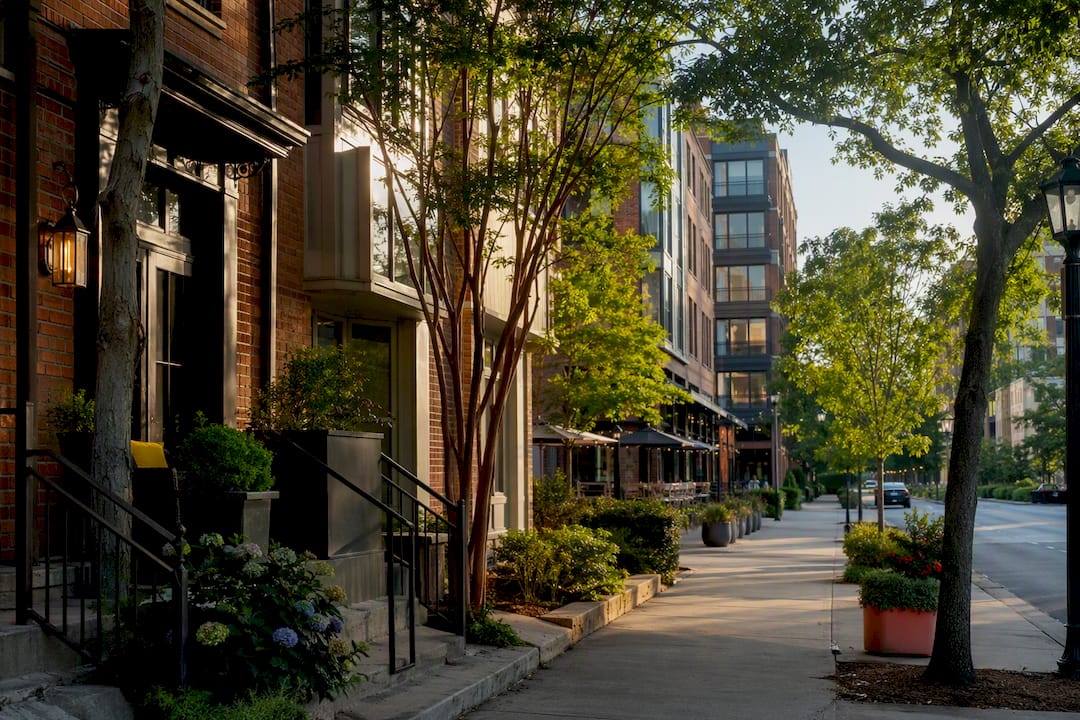
Durham suits movers who want urban culture, a broader housing supply, and closer ties to healthcare and tech employers. Chapel Hill suits those who want a quieter, college-centered town with top-rated schools and are willing to pay more for less inventory. Durham's median home price runs close to $396,000, versus roughly $631,000 in Chapel Hill, and Duke, UNC, and Research Triangle Park anchor the job base on both sides. The Durham County Market Trends report supports just how wide that housing gap has become.
TL;DR:
- Durham offers more housing options and lower median home prices, averaging around $396,000, compared to Chapel Hill's roughly $631,000, with a 47.9% cost difference.
- Chapel Hill's higher costs are driven by limited available land, tighter housing supply, and increased demand for desirable neighborhoods near schools and campus.
- Durham's economy centers on healthcare, biotech, and tech industries, making it ideal for job seekers in those fields, while Chapel Hill focuses more on education and government roles tied to UNC.
- Schools and safety are priorities, with Chapel Hill providing higher-rated schools and lower crime rates, making it more attractive for families prioritizing education and security.
- The choice depends on daily routines and priorities; Durham offers diversity and vibrancy at a lower price, while Chapel Hill provides stability, predictability, and higher school quality for a higher cost.
The numbers tell most of the story before you even tour a neighborhood. Durham is the bigger, more affordable, more industry-diverse option; Chapel Hill is smaller, pricier, and built around one institution.
| Metric | Durham | Chapel Hill |
|---|---|---|
| Overall cost of living | Baseline | About 9.1% higher (BestPlaces) |
| Median home price | ~$396,394 | ~$631,166 (HomeSnacks) |
| Median rent | Lower, broader supply | Higher, tighter supply |
| Population | ~283,506 (Wikipedia) | Smaller, college town scale |
| Crime rate (per 100k) | 4,419 total | 2,687 total (HomeSnacks) |
| School quality | Solid, improving | Generally higher rated |
| Dominant industries | Healthcare, biotech, tech, research | Education, government, nonprofits |
| Best for | Urban amenities, job variety, value | Schools, safety, college-town calm |
BestPlaces and HomeSnacks both track Chapel Hill's housing costs running roughly 48% above Durham's, and WhyThere's side-by-side numbers land in the same range. That consistency across three independent trackers is worth noting when you're building a budget.
Durham feels like a city rebuilding itself in real time. Old tobacco warehouses now hold breweries, restaurants, and offices, and that redevelopment energy shows up in neighborhoods across town.
Chapel Hill runs quieter and smaller in scale, organized around Franklin Street, the commercial spine lined with bookstores, coffee shops, and campus bars. Neighborhoods like Southern Village and Meadowmont offer walkable, planned communities near greenways and parks, trading nightlife variety for calm and consistency.
Money is where this comparison gets concrete fastest. Chapel Hill runs about 9.1% more expensive overall than Durham, and housing alone drives most of that gap, with Chapel Hill costs running roughly 47.9% higher.
Why the gap exists and what it means for your budget:
Statistic Callout: Chapel Hill's median home value sits near $631,166 against Durham's $396,394, a gap of roughly $235,000 according to HomeSnacks.
Your paycheck often decides this move before your preferences do. Durham anchors the region's healthcare and biotech economy, earning its old nickname "City of Medicine" with more than 300 medical and health-related companies tied to Duke University School of Medicine and Research Triangle Park.
Families weighing this decision usually start with schools and crime data, and the two cities diverge here more than almost anywhere else in this comparison.
Numbers only get you so far. Walking a street tells you things a spreadsheet cannot.
Durham's downtown grocery and hospital access tends to beat Chapel Hill's on convenience; Chapel Hill wins on quiet, tree-lined streets close to campus amenities.
Weigh these factors in order of what actually affects your daily life, not just your first impression on a single tour.
Pro Tip: In Chapel Hill's tighter market, homes in good condition near Southern Village or Meadowmont often get multiple offers within days. If you're serious about that area, get your financing pre-approved before you start touring, not after you find the one you want.
Read our buyers guide for a full walkthrough of the process, and check our tips for moving to Durham in the summer if your timeline lines up with peak moving season.
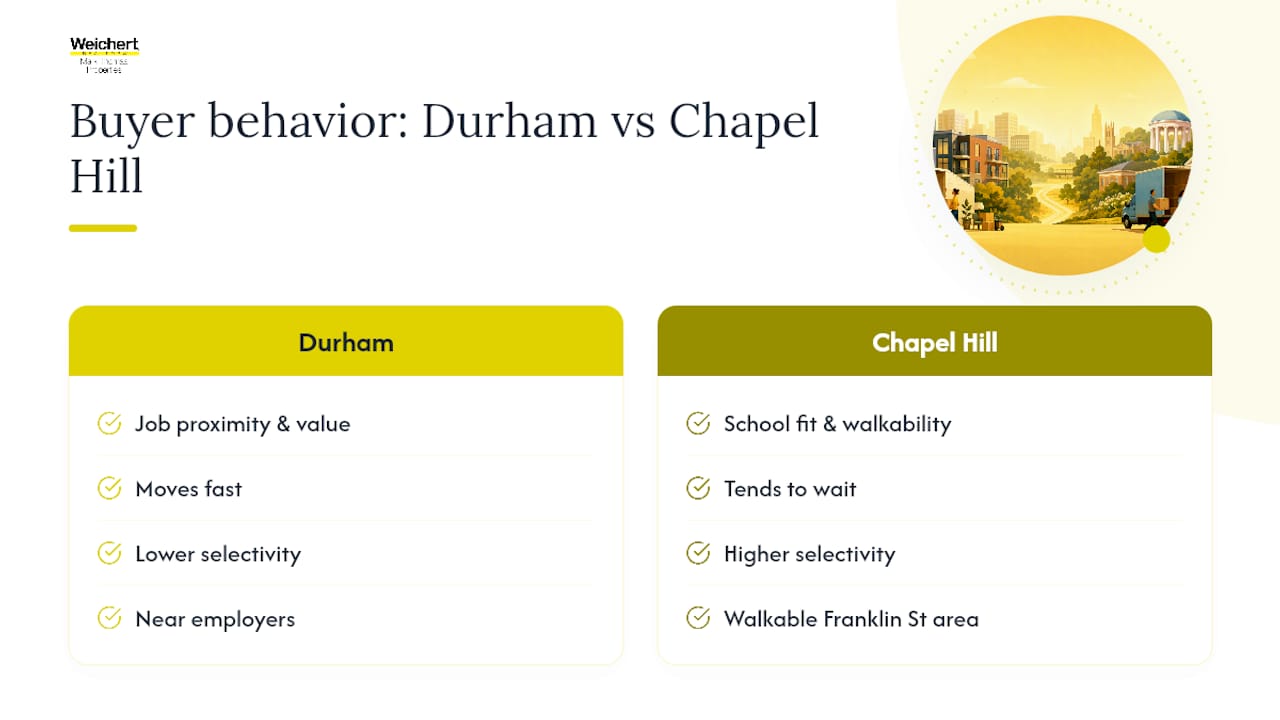
We track both markets closely through the Durham County Market Trends and Alamance County reports, and one pattern shows up again and again: buyers chasing job proximity and value tend to move fast on Durham listings, while Chapel Hill buyers tend to be pickier and more patient, waiting for the right school zone or walkable block near Franklin Street. Neither pattern is wrong. They just reflect different priorities.
Mebaneliving gives you something the cost calculators can't: an actual search tool that filters listings by price, school zone, and commute distance across Durham, Chapel Hill, and the surrounding Triangle towns, so you're comparing real inventory instead of citywide medians.

Set up saved searches and email alerts so new listings in your target neighborhoods reach your inbox before they hit the broader market. If selling your current home is part of this move, our seller's guide and options for comparing selling paths walk through timing and pricing strategy, and this short video covers what to expect from listing to close. Buyers can start with our buyer's guide or this quick buyer walkthrough. If you're weighing rentals or need property management once you own, our team runs a dedicated property management site with homes for rent and home watch services for owners who travel. Also browse current homes for sale in Mebane if you're widening your search beyond Durham and Chapel Hill. Pull the latest Alamance County Market Trends report and start a tailored search on Mebaneliving today.
Every comparison chart makes this decision look like arithmetic: add up the cost of living, subtract the crime rate, multiply by school rating. It isn't. The real question is which daily routine you actually want to live inside, and that's harder to quantify than a median home price.
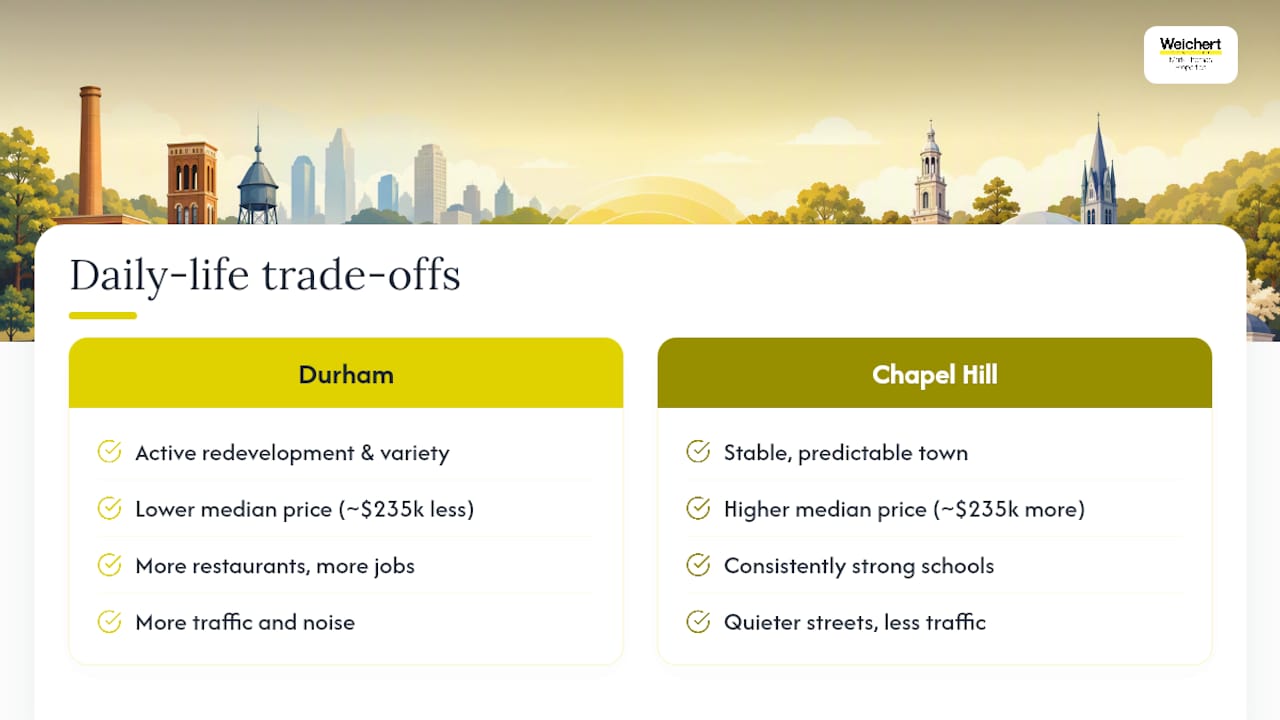
Durham's redevelopment story is genuinely compelling, but it comes with the noise and unevenness of a city still finding its shape. You'll get better restaurants, more job variety, and a lower price tag, but also more traffic and a less predictable neighborhood-to-neighborhood experience. Chapel Hill's appeal is the opposite kind of promise: predictability. The schools are consistently strong, the streets are quiet, and the town has been the same basic size for decades because it physically cannot sprawl. That stability costs you nearly $235,000 more in median home price, and it's a fair trade for plenty of families, but it's not automatically the "better" choice just because it's calmer.
What I'd push back on is the assumption that one city is objectively superior. The data shows real differences in cost, safety, and schools, but those differences only matter in proportion to what you actually value day to day. A grad student commuting to RTP has almost nothing in common, priority wise, with a family enrolling two kids in Chapel Hill schools. Don't let a ranked list decide for you. Let your actual weekly routine decide, then use the numbers to confirm you can afford it.
— Chelsea
"Nicer" depends on what you value. Chapel Hill offers quieter streets and higher-rated schools, while Durham offers more cultural variety, dining, and job diversity, so it's genuinely a matter of fit rather than one city outranking the other.
No. Durham is the bigger city by population and land area within the Triangle, while Chapel Hill is a much smaller college town.
Durham has pockets of significant wealth tied to Duke, RTP, and biotech employers, but citywide it runs less expensive than Chapel Hill, with median home prices roughly $235,000 lower.
Chapel Hill isn't a Little Ivy itself, but it's home to UNC Chapel Hill, a flagship public research university sometimes grouped informally with elite public schools rather than the private Little Ivies.
If job proximity and housing value matter most, start your search in Durham; if schools and a slower pace matter most, start in Chapel Hill, and use Mebaneliving's saved search alerts to track listings in both while you decide.

Hi there! I’m Chelsea Vanderpool, a Property Manager and licensed real estate referral agent as well as team player with Sam Paynter for buying and selling with Weichert REALTORS®, Mark Thom....
For most North Carolina homeowners, American Home Shield is the strongest overall pick thanks to its generous HVAC caps and openness to older systems, a big deal in a state where humidity runs hard
Durham suits movers who want urban culture, a broader housing supply, and closer ties to healthcare and tech employers. Chapel Hill suits those who want a quieter, college-centered town with top
Instant Home Valuation vs. a Real Agent's Comps: Which Should You Trust?You type your address into a website, hit enter, and seconds later a number pops up: your home value. It feels authoritative.
You already own a rental in Durham, Mebane, Chapel Hill, or Burlington. So the question isn't whether property management is worth it in theory. It's whether the monthly fee feels like a real
 Copyright 2026 Triangle MLS, Inc. of North Carolina. All rights reserved.
The data relating to real estate for sale on this web site comes in part from the Triangle MLS, Inc. of North Carolina. Real estate listings held by brokerage firms other than Weichert, Realtors® - Mark Thomas Properties - Durham are marked with the Broker Reciprocity logo and detailed information about them includes the name of the listing brokers. Brokers make an effort to deliver accurate information, but buyers should independently verify any information on which they will rely in a transaction. The listing broker shall not be responsible for any typographical errors, misinformation, or misprints, and they shall be held totally harmless from any damages arising from reliance upon this data. This data is provided exclusively for consumer's personal, noncommercial use.
Closed (sold) listings may have been listed and/or sold by a real estate firm other than the firm(s) featured on this website. Closed data is not available until the sale of the property is recorded in the MLS. Home sale data is not an appraisal, CMA, competitive or comparative market analysis, or home valuation of any property.
Listings marked with an icon are provided courtesy of the Triangle MLS, Inc. of North Carolina, Internet Data Exchange Database.
This site is monitored for scraping. Any use of listing data obtained from this web site, other than by a consumer looking to purchase real estate, is prohibited.
This data has been updated as of September 15, 2026 5:39 PM UTC
Copyright 2026 Triangle MLS, Inc. of North Carolina. All rights reserved.
The data relating to real estate for sale on this web site comes in part from the Triangle MLS, Inc. of North Carolina. Real estate listings held by brokerage firms other than Weichert, Realtors® - Mark Thomas Properties - Durham are marked with the Broker Reciprocity logo and detailed information about them includes the name of the listing brokers. Brokers make an effort to deliver accurate information, but buyers should independently verify any information on which they will rely in a transaction. The listing broker shall not be responsible for any typographical errors, misinformation, or misprints, and they shall be held totally harmless from any damages arising from reliance upon this data. This data is provided exclusively for consumer's personal, noncommercial use.
Closed (sold) listings may have been listed and/or sold by a real estate firm other than the firm(s) featured on this website. Closed data is not available until the sale of the property is recorded in the MLS. Home sale data is not an appraisal, CMA, competitive or comparative market analysis, or home valuation of any property.
Listings marked with an icon are provided courtesy of the Triangle MLS, Inc. of North Carolina, Internet Data Exchange Database.
This site is monitored for scraping. Any use of listing data obtained from this web site, other than by a consumer looking to purchase real estate, is prohibited.
This data has been updated as of September 15, 2026 5:39 PM UTC
